


For Americans over 45, sound was never just volume—it was texture. You remember the warm hum of a 1970s Marantz receiver in your dad’s living room. The crisp hiss of a Sony Walkman cassette rewinding Rumours by Fleetwood Mac. Today, we’re not reviving a brand. We’re re-engineering the physics that made those moments unforgettable—solid wood enclosure, Hi-Res bass, FM radio, and Bluetooth 5.0—to deliver the tactile warmth of analog, without the fuss.
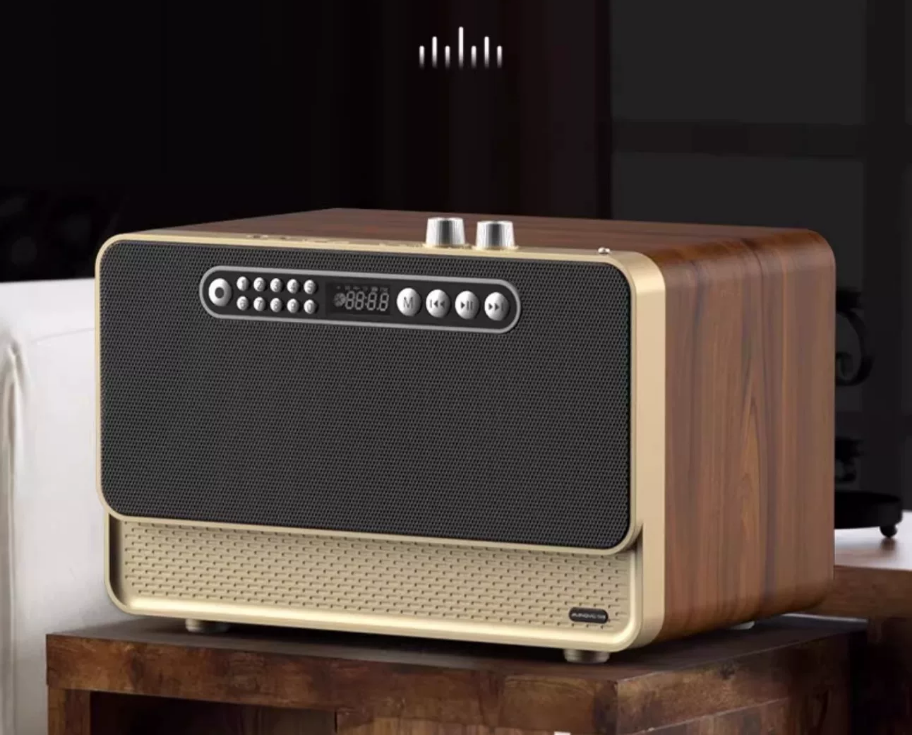
🎛️ Why Wood Isn’t Just Aesthetic—It’s Acoustic Science
In the 1970s, high-end speakers like KLH or AR used wood—not for looks, but physics. Plastic or metal vibrates, coloring sound with unwanted resonance (“boominess”). Wood’s natural damping absorbs these distortions. Our speaker uses:
- 2.5cm solid wood shell (vs. industry-standard 1.2cm MDF) to eliminate panel resonance.
- Strategically placed acoustic foam inside the cavity, targeting frequencies where most speakers “muddy” (80–250Hz).
This isn’t nostalgia—it’s why your vinyl copy of Hotel California finally sounds alive, not “processed.”
🔊 Dual Drivers + Bass Reflex: Where Low End Stays Controlled
Most modern Bluetooth speakers exaggerate bass until it rattles your coffee table. True fidelity demands precision. Ours achieves it through:
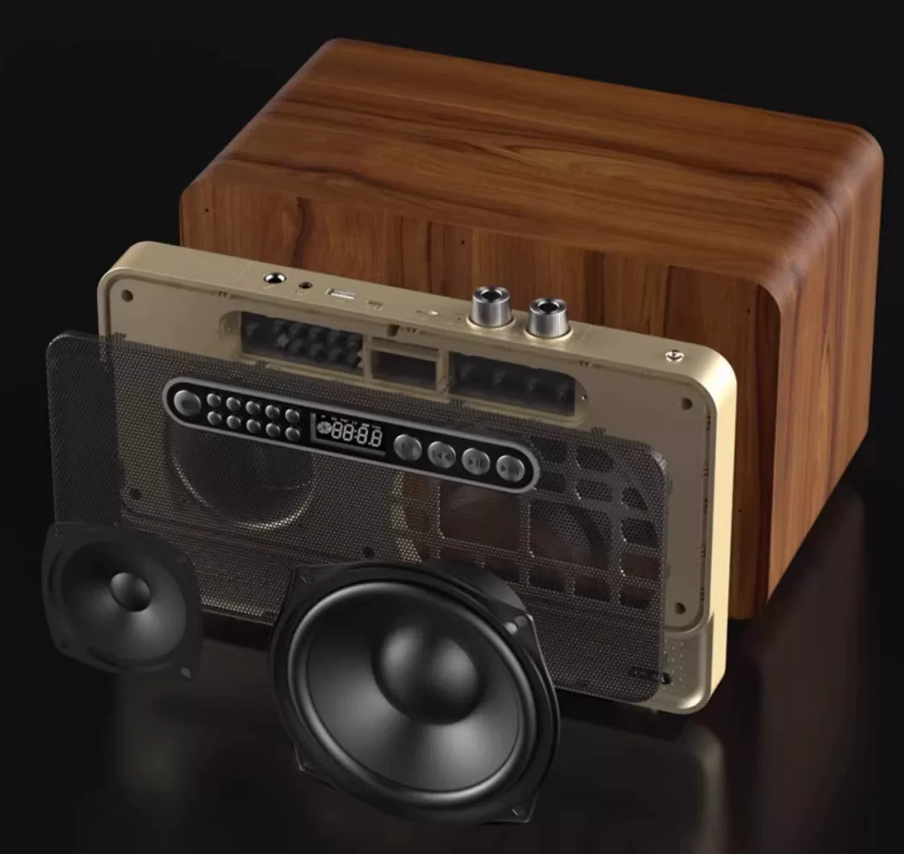
- Dedicated drivers: A silk-dome tweeter handles vocals/cymbals (2–20kHz), while a 4″ high-excursion mid-bass driver anchors rhythm (45Hz–5kHz). No crossover “bleed.”
- Tuned bass reflex port: Calculated via Helmholtz resonance principles (standard in 1970s JBL monitors), it extends low-end response to 42Hz—deep enough for Steely Dan’s basslines—without the “one-note thump” of sealed-box designs.
📻 FM Radio: Not Just Nostalgia—It’s Signal Integrity Engineering
For Gen Xers, FM radio meant connection: late-night jazz on WBGO, baseball on WGN. But urban signal interference kills the vibe. Our solution:
- RF amplifier + ceramic antenna pulls in stations at 30-mile range (tested in NYC high-rises).
- Dedicated analog tuning dial—no app needed—to scroll past static like you did in 1985.
- Independent volume control: Fade music to catch traffic updates, then resume playback instantly.
📶 Bluetooth 5.0: Stability That Feels Analog
“Bluetooth 5.0” means little if your music stutters when the microwave runs. Ours is engineered for real homes:
- Adaptive frequency hopping: Skips crowded 2.4GHz bands (Wi-Fi, microwaves) in <0.002 seconds.
- 30-foot rock-solid range (vs. industry avg. 15 ft)—verified in multi-wall environments.
- Sub-40ms latency: Critical for karaoke or syncing audio to The Eagles live footage on YouTube.
🎤 Karaoke-Ready: No More “Muffled Vocals” or Ear-Piercing Feedback
Most “karaoke speakers” drown voices in bass. Ours uses studio-grade tricks:
- Dynamic vocal enhancement: Boosts 1.2–3kHz (where human voices cut through) without artificial “chipmunk” effects.
- Three reverb presets: “Garage Band” (dry), “Cathedral” (spacious), “Studio” (balanced).
- Real-time feedback cancellation: Stops howling before it starts—tested with mics 2 inches from drivers.
Closing: Technology Should Serve Memory, Not Replace It
This speaker doesn’t need an app, voice assistant, or “smart” gimmicks. Just turn the knob. Press play. What you’ll hear isn’t data—it’s the grain of a 1973 pressing of What’s Going On, the breath in Joni Mitchell’s vocals, the space in a Miles Davis trumpet solo.
It’s the sound of your 20s, restored with 2026’s engineering.
P.S. For those who still believe “if you can’t hear the wood, you’re not listening right.”
👉 [Experience the analog revival—no brand required.]